Our Claude Code book hit #1 on Amazon
I’m Oikon. I co-authored Claude Code実践入門 [生成AI深掘りガイド] (Practical Introduction to Claude Code) with Aoi Maekawa of KDDI Agile Development Center (KAG).
As the title says, I am happy to report that the book hit #1 in Amazon’s Computers & IT bestseller ranking!
Computers & IT sits here in Amazon’s category tree:
- All categories
- Books
- Computers & IT ← here
- Programming
- Applications
- Databases
- …and so on
- Computers & IT ← here
- Books
The editor at SB Creative told me it is quite a large category, so ranking first there is a big deal.
Claude Code実践入門 [生成AI深掘りガイド] が「コンピュータ・IT 」でベストセラー1位になりました!🥇 大きいカテゴリなので嬉しいです!購入していただきありがとうございます!感想やコメントもお待ちしています amzn.asia/d/0h6tkzCL #ClaudeCode深掘りガイド

I think this comes from the broader momentum around Claude Code, and from what the Fukabori (deep-dive) series authors, Minoru Mita (Minorun), Kazuaki Morita, Hiroshi Kumada, Yu Otsubo, and Masaki Tsukada, together with SB Creative, have built up.
For reference, these are the books in SB Creative’s Fukabori series.

Now, the authors (mostly me) search for mentions whenever there is spare time, picking up comments and questions from readers. About a week after launch, a lot of feedback has come in, so in this post I want to go through some of it and share my own opinions and where I stand on Claude Code.
I will mainly draw from:
- Posts on X with the #ClaudeCode深掘りガイド hashtag
- Amazon reviews
- Other things I found while searching for mentions
Let me sort the comments roughly and go through them.
Comments about the book
Full color really is easier to read

「Claude Code実践入門 [生成 AI 深掘りガイド]」(SB クリエイティブ)をご献本戴きました。Oikon ( @oikon48 ) さん、有り難うございます。現在、ベストセラー1位になってますね! amzn.asia/d/08DAj8r8 早速拝読しています。フルカラーはやはり読みやすい!w

Many people commented that full color is easy to read, or simply that full color is nice.
Yes! The book is in full color!
All 336 pages of it. Absurd, right?
When SB Creative told me during the writing that the book would be full color, I did not think much of it. Once it became an actual book, I understood just how much full color helps.
Claude Code is a tool with a simple screen, but the benefit of full color is immeasurable. What we wanted to express landed on the page almost as is, which made everything dramatically easier to follow. Authors of other technical books told us they were jealous we got full color.
Seeing the first full-color proofs also sparked ideas for expressions that only work in full color, and several of them made it into the book. If you have read it, you will know the ones.
Chapters 5 and 6 on enterprise use are strong
というわけで『Claude Code 実践入門』、食べ終わったので感想。 まず第4章までのClaude Codeの基本的な使い方や拡張などについては、多くが他の類似書籍にもある内容ですが、おそらくは初心者が入りやすいよう小難しい説明は少なめでスッキリまとめられている印象です。 初めてClaude

Oikonさんと前川さんの共著『Claude Code 実践入門』が届きました! 食べていきます!

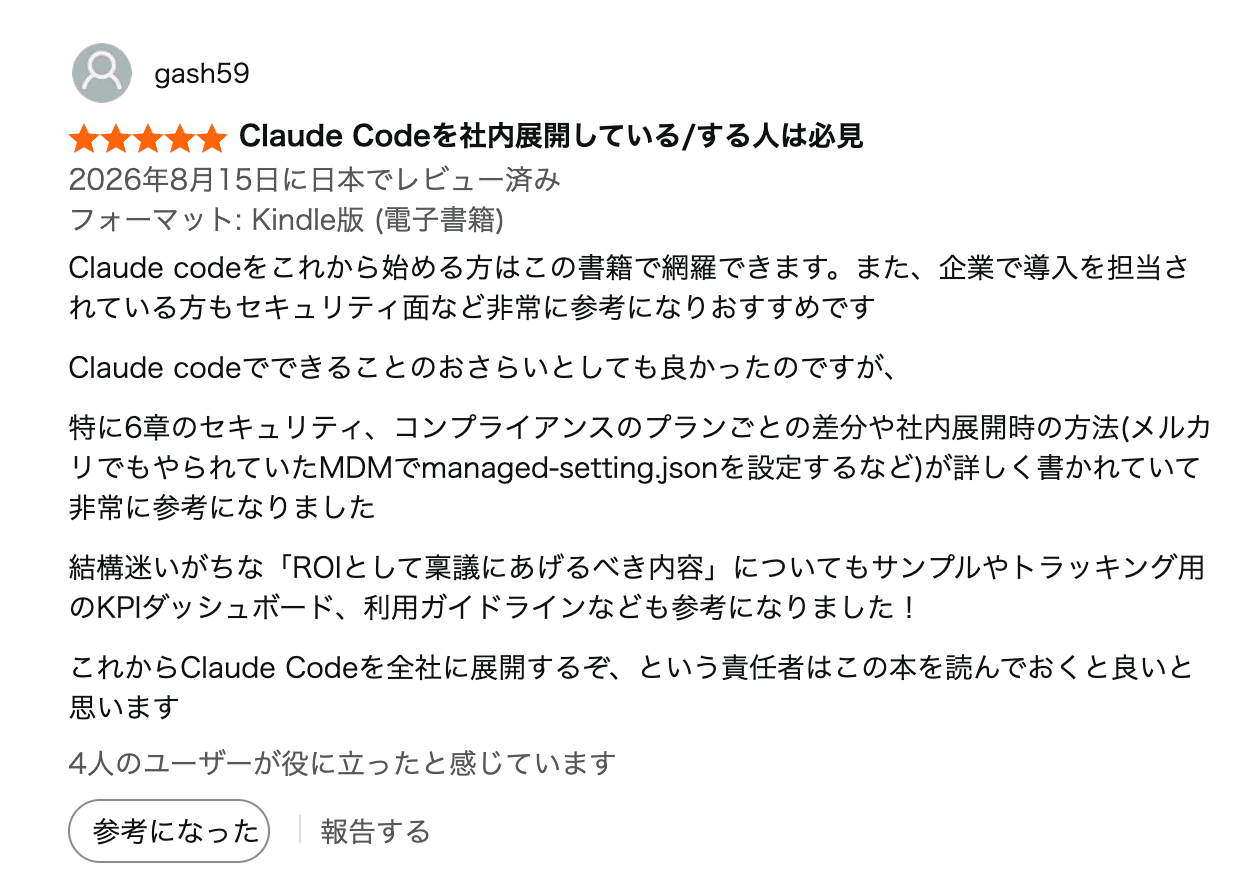
Reading through the comments, a remarkable number of people praised chapters 5 and 6.
Chapters 1 through 4 take stock of the Claude Code fundamentals, which other books also cover. Chapters 5 and 6 cover Claude Code for team development and automation, and what to watch out for when using it across an organization. As far as I know, almost no other Claude Code book covers this, and I think that makes it one of a kind.
As I wrote in a previous post, Claude Code has become widely recognized, and adoption is now shifting from individuals to organizations. Until last year, a single feature or piece of know-how was revolutionary on its own. Running a project with multiple people requires practicing Claude Code from a different perspective.
When we planned the book in February, I was sure this organizational material would become necessary, so we decided to fold in the experience of KAG and Maekawa, who adopted Claude Code early and had been discussing adoption with their customers. Seeing the reactions now, I think it was the right call.
Some people are probably thinking “another Claude Code book?”, but this one approaches Claude Code from a different angle than the previous ones, and there should be something in it to learn.
Good call focusing on the CLI

「Claude Code実践入門」届いた!まだざっと見ただけですが、-pの構造化出力、しらなかった! 感銘を受けたのは、IDE統合の話、Claude Desktopのはなしがなかったこと。


Claude Code実践入門 [生成AI深掘りガイド] が本日発売されます! 久々に記事も書いたので、こちらもどうぞ! #ClaudeCode深掘りガイド x.com/i/article/2087…

こちらの本をひと通りざっと目を通したので皆さんにも内容のご紹介を。 入門した人、使い慣れてる人、双方にとって値段以上の価値があると言えると思います。 特に豊富な拡張機能の種類や使い分けに言及されていて、その判断基準まで示されている点には助かりました。
Claude Code実践入門 [生成AI深掘りガイド] が本日発売されます! 久々に記事も書いたので、こちらもどうぞ! #ClaudeCode深掘りガイド x.com/i/article/2087…
The book restricts itself to the Claude Code CLI. Most of the reasons are in the book, but here is one that is not: Claude Code users overwhelmingly use the CLI.
I ran polls on X a while back.
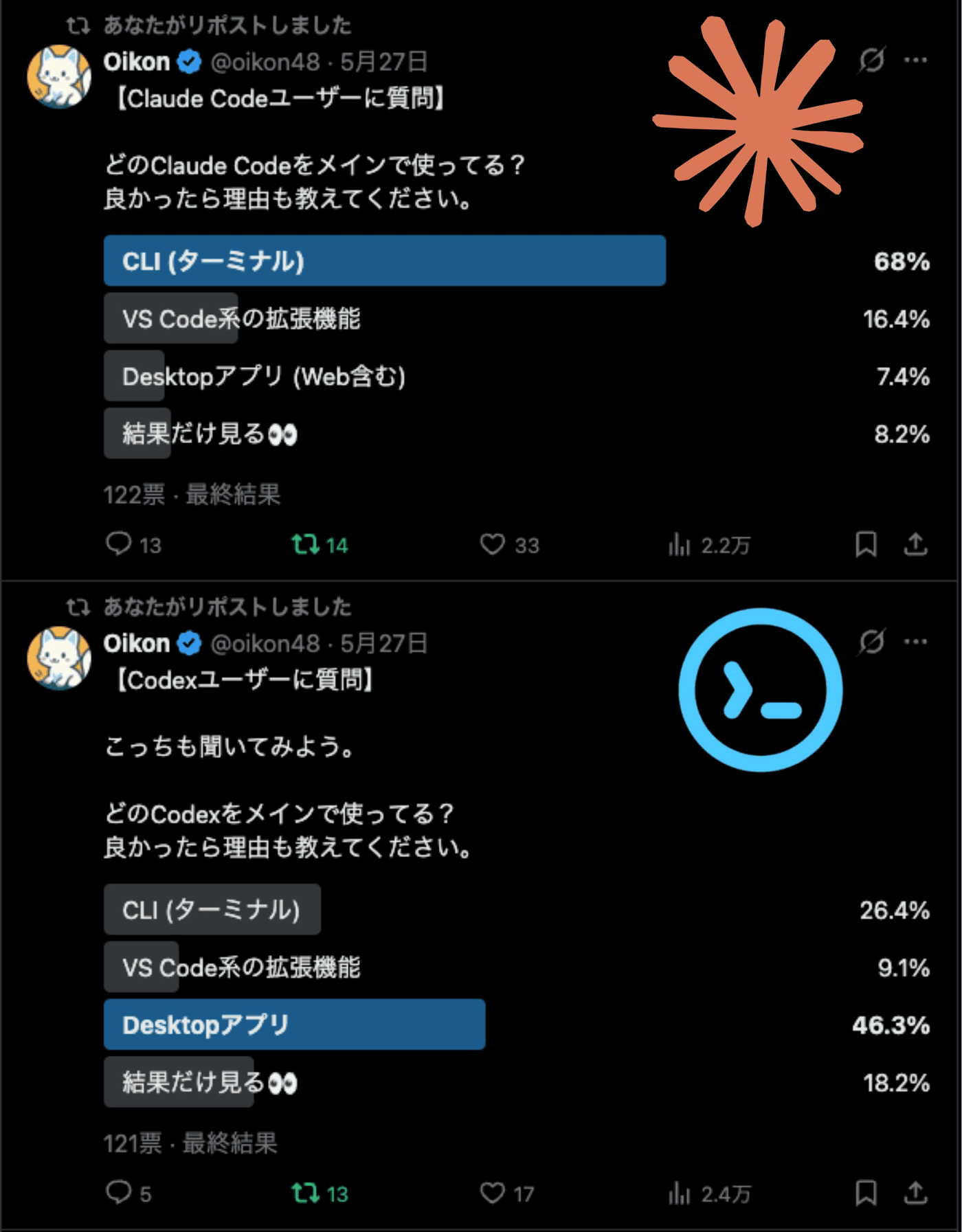
I asked Claude Code and Codex users which interface they mainly use. Codex leaned toward the Desktop app, while Claude Code respondents overwhelmingly answered the CLI (terminal). That matches my own sense of things.
Also, once you cover the VS Code extensions and the Desktop app, UI changes can shake the content badly. To keep the book useful for as long as possible, we narrowed it down to the CLI (terminal).
That said, there is one thing I want to mention here: the book actually has an appendix covering VS Code and the Desktop app.
The book has a hands-on repository, and the appendix lives there as separate material. If you want to check it, follow the repository link in the book. It records how the VS Code extension and Desktop app screens map to the CLI operations, for everything the book covers.
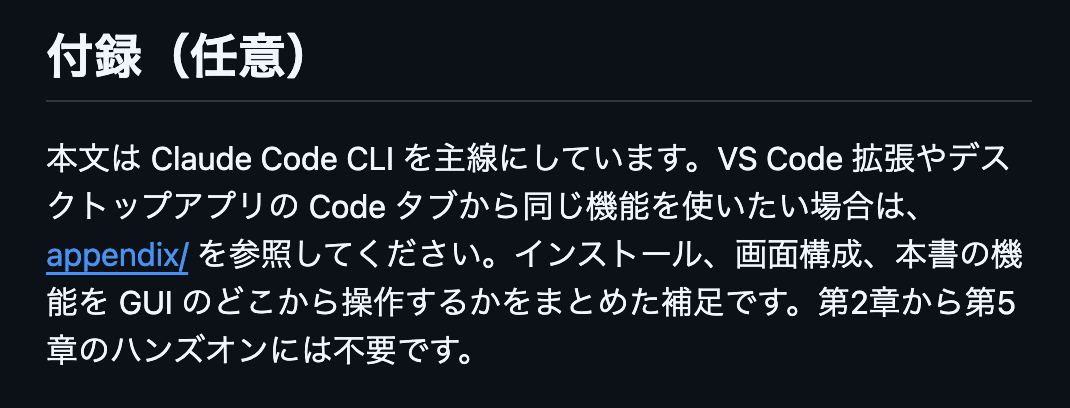
The appendix alone runs more than 20 pages, but for page-count reasons all of it became downloadable content. A shame.
Opus 5 is in the book

#ClaudeCode深掘りガイド 読みました! まず全体感として、分かりやすく網羅的で、情報も新しいため、ソフトウェアエンジニアには広くオススメです Opus5が反映されているように、紙の本なのに1ヶ月未満の直前情報まで取り込んでいるのに驚きですね…!
The text of this book includes Claude Opus 5. I am glad someone noticed.
Claude Opus 5 was released on July 24, 2026, and the book came out on August 14 of the same year. Quietly impressive, right?
Many people assume a book’s content is locked once its Amazon page goes up (around June for this book), but we kept chasing information we could fold in until the very last minute. Of course, model releases will keep coming, so we also tuned the writing to depend as little as possible on model numbers and performance.
I have followed Claude Code’s updates and behavior changes almost daily since its early days, and that experience let me reflect what belonged in the book right away. Claude Opus 5 is the visible example, but we also triaged the smaller changes and folded in as much as we could.
The chapters on understanding Claude Code’s features (mainly 2 through 4) also keep the information as current as we could make it. Even longtime Claude Code users should find something new.
Learning Claude Code from a paper book

I don’t know why anyone would learn Claude Code by reading a book, but apparently it’s a thing in Japan


On the day I was writing this article, an interesting topic crossed my timeline, so let me pick it up.
I don’t know why anyone would learn Claude Code by reading a book, but apparently it’s a thing in Japan
It was interesting to see the range of opinions in the replies and quotes.
There are a few common reasons books get published:
- As a hobby or as work
- To organize a field systematically
- To build the author’s credibility
- Because publishers sell books
- Japan’s commercial publishing culture
- And various others
My read is that the post blew up because of opinions like these:
“Learning a fast-moving tool like Claude Code from a book is silly”
“Just read the official docs and use it”
“If something is unclear, ask an AI”
“It is probably a hollow info product anyway”
For what it is worth, my own practice with Claude Code is exactly that: follow the daily changelog, read the official docs, use the tool, and ask Claude Code when something is unclear.
This goes beyond Claude Code and other AI tools. It connects to the broader “why read books when you can ask an AI and have it do the thing” argument.
So what is the point of reading a paper book about a tool like Claude Code?
Personally, I think one real value is learning a field systematically through a book and gaining knowledge “hooks” through the author’s experience and thinking. (By “hook” I mean something like a drawer in your memory that reminds you a concept or technique exists.)
These days an AI can tell you most things, but you cannot ask good questions without knowing the keywords and concepts in the first place. Most of those come from your own accumulated experience as hooks, and one way to gain them is to trace an author’s systematic knowledge and skills through a book.
As an example, the book covers enterprise use of Claude Code. What should you do about working with your compliance team? If you have read the book once, “Compliance API” catches on a hook, and you can start investigating and using it from there.
You can earn hooks by digging on your own, but getting them through books is a perfectly valid path too.
Closing
It has been about a week since Claude Code実践入門 [生成AI深掘りガイド] came out, and I have received all kinds of feedback. Thank you! I am learning from it as well.
If you are going to read the book, I would be happy if you posted on X with the #ClaudeCode深掘りガイド hashtag or left a review on Amazon. I will absolutely go and read them.
![Book cover of Claude Code実践入門 [生成AI深掘りガイド]](/images/works/claude-code-practical-guide.jpg)
I also wrote a post on launch day. Have a look if you are interested.