Thoughts on writing a Claude Code book
I’m Oikon. I had been posting things like “Claude Code is fun!” on X, and somehow that turned into a book. It comes out on August 14, 2026, the same day this article is published.
The book is Claude Code実践入門 [生成AI深掘りガイド] (Practical Introduction to Claude Code), from SB Creative. I co-authored it with Aoi Maekawa of KDDI Agile Development Center.
![Book cover of Claude Code実践入門 [生成AI深掘りガイド]](/images/works/claude-code-practical-guide.jpg)
Honestly, I never thought I would work on a book. You really never know what life will throw at you.
I wanted to write something for launch day. Part of that is simply that I had not had enough time to write articles while the book was in progress.
I want to put down how the book came about, and why I decided to write about an AI tool that moves as fast as Claude Code.
Getting asked to write a Claude Code book
The offer came around February 2026. Minoru Mita (Minorun) at KDDI Agile Development Center (KAG) asked whether I would write a Claude Code book with younger members of KAG.
I had been posting about Claude Code on X (Twitter) for almost a year, and talking about its features and behavior in the community as well, so I think that is why they reached out.
I had wanted to write a technical book, but I also wondered whether there was any real point in writing one about an AI tool that evolves this quickly.
There were already Claude Code books out: Hirakawa’s Claude CodeによるAI駆動開発入門, and Generative Agents’ 実践Claude Code入門―現場で活用するためのAIコーディングの思考法. I thought hard about what another Claude Code book could add.
At the time we were planning it, Claude Code was starting to be known not only among engineers but more broadly, and a lot of people asked me “so, how is Claude Code?” What I personally felt was that on X (Twitter) you see plenty of individuals using it very fluently, while most people in general are still figuring it out. Claude Code was getting attention, but organizational adoption still looked like a coming phase, and from talking to people I started to think many organizations would hit problems when that phase arrived.
Fortunately, KAG, the team that brought us the project, had adopted Claude Code early in their own organization and was also talking with other companies’ customers about introducing it. They had an approach to the gap I had been feeling. That is how I ended up writing with Aoi Maekawa of KAG, on the theme of practicing Claude Code as an individual and in an organization.
The work took about six months. On weekdays I spent 3 to 5 hours on Claude Code research, verification, writing, and editing, and more than 6 hours on weekends. I was working a day job, so I think the limited time actually helped me focus. It also helped that I had already been collecting Claude Code information. Searching posts on my X account (@oikon48) was enough to sweep up release notes and similar updates.
Why put Claude Code on paper
AI tools move fast. Claude Code in particular ships often. If you plot the last year of releases as a contribution graph, it looks like this.
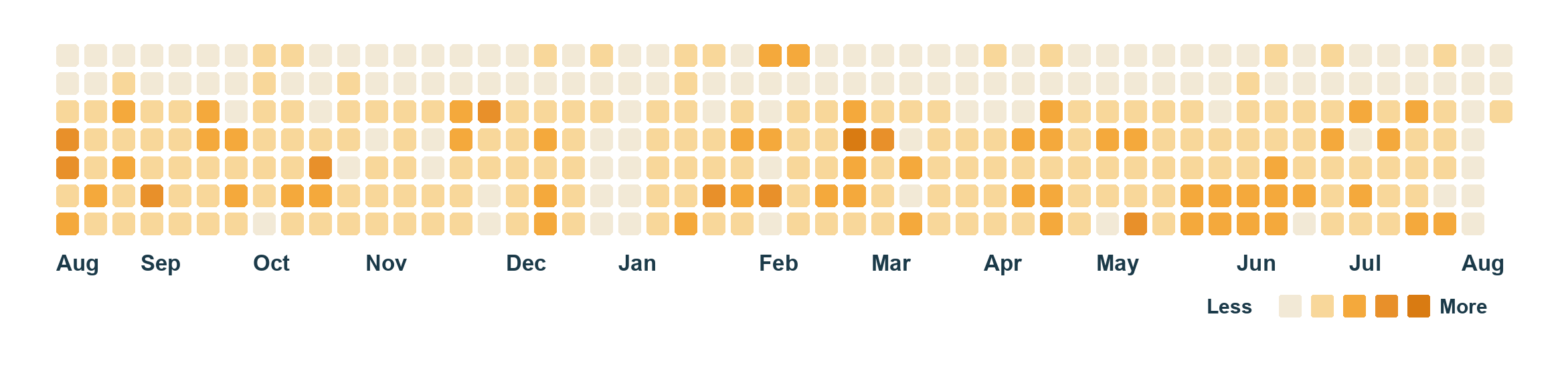
Based on npm publish dates, the past year had 310 releases, updates on 237 days, and as many as 4 in a single day. The public total was 354 releases (as of early August 2026). Skim the CHANGELOG and the volume is overwhelming. I go through each new update, but undocumented changes show up from time to time, and the official Claude Code docs are wrong more often than you would like.
Writing a book about an AI tool that moves this fast is, if I say so myself, a bit eccentric.
As an aside, some equally eccentric friends of mine are apparently putting out a book on OpenAI’s Codex, the counterpart to Anthropic’s Claude Code. I am looking forward to it.
Anyway.
With Claude Code, a tip that worked last week is often replaced by a new feature the next. Recently, for example, an Anthropic engineer shared that it helps to ask Claude Code to write specs and reports in HTML rather than Markdown.

I saw a lot of people copy that by making Skills that generate HTML. Then Claude Code shipped Artifacts as an official feature, and for similar uses that feels like the better default now. Another example: people used to steer Claude Code with a Markdown task list. The Tasks system now handles a fair amount of that on its own, so that tip also feels outdated.
So what is the point of putting short-shelf-life AI tool information into a paper book? For me it was two things: you can gather the material into a systematic account on paper, and you can share organizational knowledge that does not fit inside one person’s workflow. That is why I wrote this book.
I post about small Claude Code updates and behavior changes on X (Twitter), but honestly most people do not need to follow that closely. If chasing Claude Code updates is your hobby, the way it is mine, go for it. You can still use AI tools well without doing that. Most tips that flow through X (including my own posts about minor updates) are not worth chasing that hard for most people.
The people I think of as actually good with tools like Claude Code and Codex seem to understand what the tool is like: what it can do and what it cannot. They have a systematic picture of how it works, how the de facto standard features are built, and why those mechanisms exist. They are probably not only catching up on news, but building skill by actually using the tools. Because they understand the system, when a new model, feature, or tool appears they can get a feel for what is inside it, and how it differs, after only a little hands-on time.
On Claude Code tips, I also think unglamorous work that helps a whole team or organization use it smoothly is worth more right now than flashy personal setups. How organizations actually practice Claude Code is still not shared much. Confidentiality is part of that. Know-how from one organization also often does not transfer directly to another. Even so, knowledge that does get shared, from introduction through organizational use, seemed worth putting in a book.
In this book I used what I have learned from watching Claude Code to keep the material useful for as long as possible, in what I chose to include and how I wrote it. Summarizing one of the fastest-moving tools in the world is hard. I think I did everything I could.
What I am glad I did
Getting a technical book published
I am an engineer, so I had always wanted to write a technical book, and I am glad I got to do it. The work was much harder than I had imagined, but it was a very good experience.
I also feel lucky that an account like mine, one that just posted about Claude Code because it was interesting, ended up getting to publish a Claude Code book. I am told the usual path is to write a proposal and take it to a publisher.
SB Creative took care of everything from planning through editing. They stayed with last-minute revisions to make a Claude Code book better despite how often the product changes. Claude Opus 5 came out from Anthropic on July 24, 2026, and even though it was a weekend, the editor at SB Creative worked with us so we could get Opus 5 into the book. Sorry for pushing such a last-minute request.
They also took suggestions about wording and put them on the page without fuss. Being able to do my first technical book with SB Creative was genuinely fortunate.
Getting to know Claude Code even better
Getting to know Claude Code even better is still the thing I am gladdest about.
I have been writing as if “writing a Claude Code book was rough,” but experimenting, verifying, and putting Claude Code into a book was not painful at all. I had a blast writing it.
Meeting Claude Code in 2025 was one of the turning points in my life. I cannot thank Boris Cherny and Anthropic enough (I would thank them even more if they eased up a bit on the rate limits).
I want to keep watching Claude Code and other AI tools grow from here.
Closing
Claude Code実践入門 [生成AI深掘りガイド] is out, so I wrote this.
I hope the book helps keep the energy around Claude Code going.
If you are going to use Claude Code on your own or in an organization, I would be happy if you picked it up.