Claude Code 1st Anniversary: What's happened and What's next
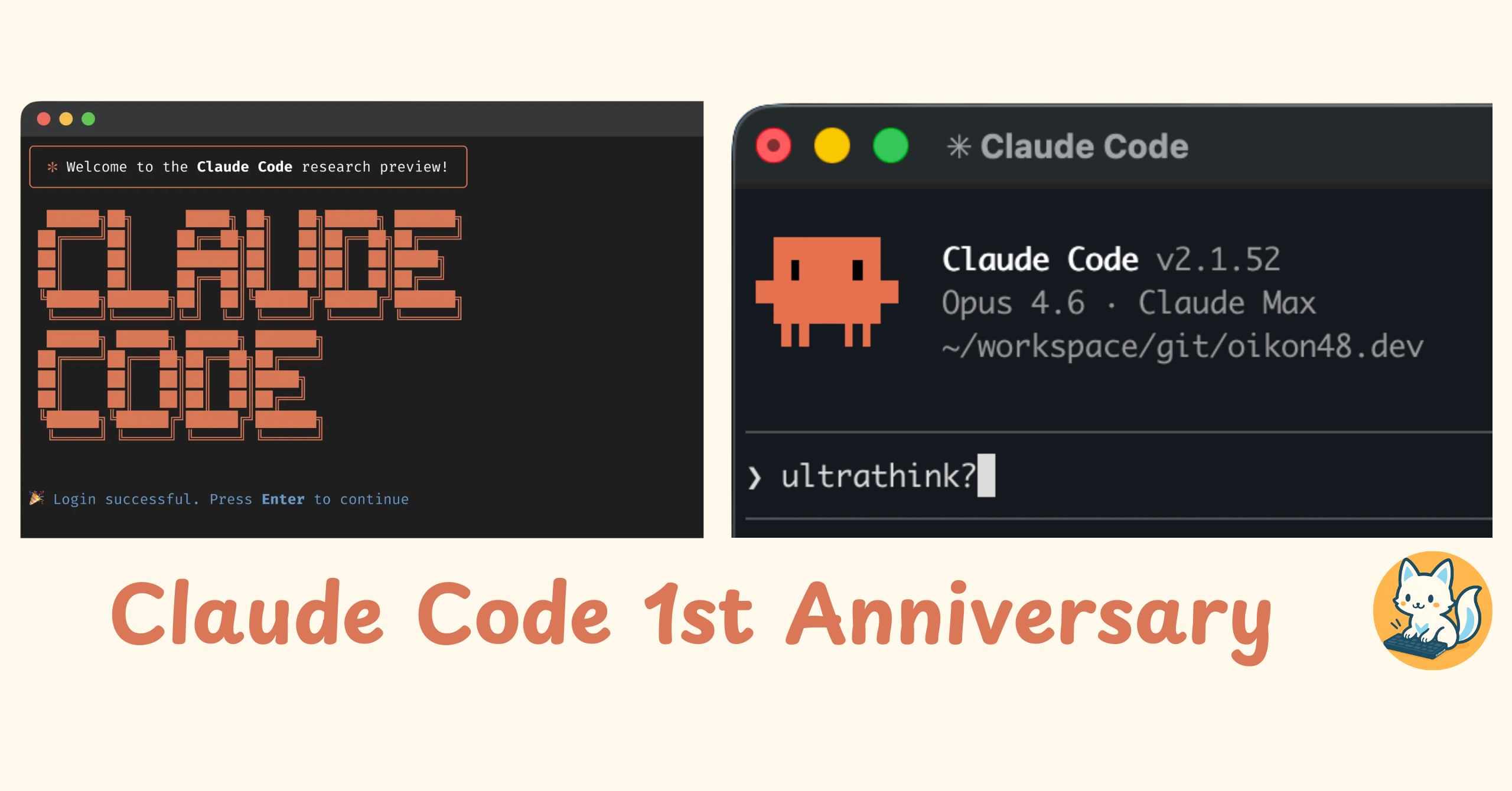
It has been exactly one year since Claude Code was released. On February 24, 2025, Claude Code launched as a Research Preview alongside Claude Sonnet 3.7.
You can find the official blog post from that time here:
Honestly, I think many people are surprised that it has only been a year since Claude Code appeared. At the very least, I still can’t believe it launched just a year ago. That’s how deeply it has become part of my daily life.
Since this is a milestone for Claude Code, I’d like to put together my thoughts on what I’ve observed and considered about it. I covered more technical topics in an article I wrote on December 31, 2025, so this time I’ll focus on more abstract themes (I put a lot of effort into that year-end article too, so please check it out if you’re interested).
I want to share my thoughts on the impact Claude Code has had over the past year and the impact that AI tools, including Claude Code, will have going forward.
The Impact Claude Code Has Had in One Year
Claude Code was released to the world on February 24, 2025. At the time, only a handful of AI tool enthusiasts were quick to adopt it. I started using it in March 2025, but nobody around me was using it at all.
From then to the present, one year later, Claude Code has seen a rapid growth in its user base. You can get a rough sense of the trend by looking at npm download numbers (of course, native installation is now recommended over npm, so these aren’t the actual numbers).
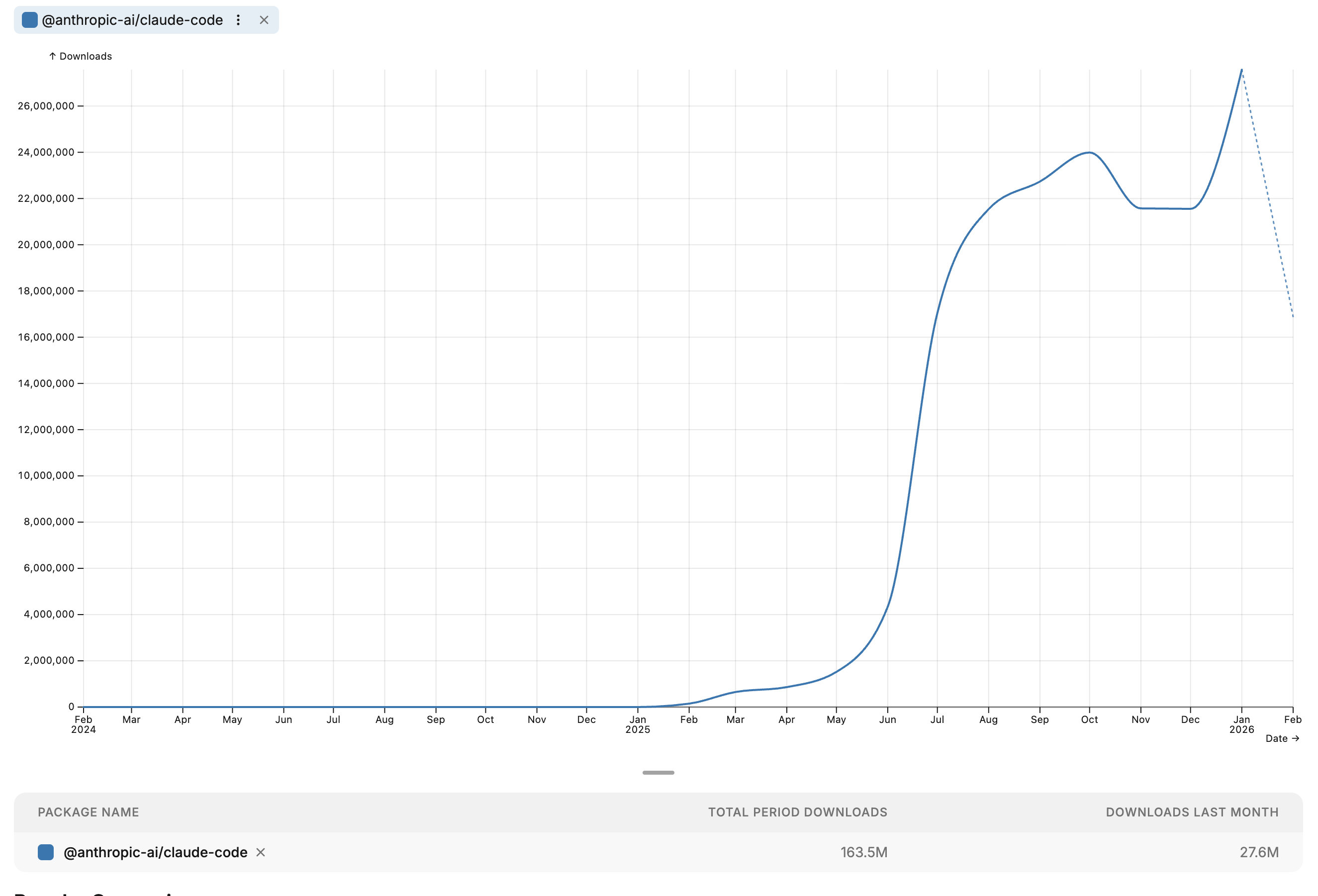
While it’s still mostly early adopters using it, I feel that Claude Code’s market share will continue to grow. That’s because Claude Code has left a significant impact over the past year.
Let’s take a look at some of the ways Claude Code has made an impact during this year.
The Importance of Being a CLI Tool
Throughout software history, tools have generally evolved from CLI to GUI. There has been a tendency to prefer UIs that can be operated intuitively just by looking at them.
When Claude Code launched, the mainstream approach to AI-assisted coding was through VSCode forks like Cursor, Windsurf, and Cline.
Claude Code arrived as a CLI tool in that landscape, and initially it wasn’t very popular. Part of this was because Sonnet 3.7 hadn’t yet reached a level that could fully bring out Claude Code’s value as a harness. But users also didn’t see much value in a CLI tool.
- Difficult to review code diffs
- Lots of commands to memorize
- Many people prefer not to work in a black terminal screen
For these reasons, Claude Code didn’t attract much attention.
However, with the arrival of Claude Opus 4.0 and the improvement of Claude Code’s harness alongside its tooling, AI coding capabilities advanced significantly. The benefits of using a CLI tool began to outweigh the reluctance to adopt one.
As Claude the LLM and Claude Code the harness evolved, the need to meticulously review code diffs diminished, and it became possible to delegate tasks to the agent.
Additionally, Claude Code’s emergence as a CLI tool drew attention to other CLI tools and scripts that AI agents could easily invoke through command-line execution. Today, CLI tools serve as the hands and feet of AI agents, playing a crucial role in significantly expanding their scope of work. The ability for any service to be executed from the CLI has become an increasingly important consideration.
Claude Code itself is a CLI tool, and it created the opportunity for other CLI tools to step into the spotlight. Personally, I think Claude Code has evolved beyond being just a CLI tool into what is essentially an Agent UI. I touched on this in my year-end article as well.
The Concept of Context
As people started exploring AI coding, the word “context” began appearing frequently. Context is the set of tokens included when a large language model (LLM) performs sampling. To put it simply, you can think of it as the memory space an AI agent can hold.
The discipline of thinking about how to compose this context to elicit desired behavior from LLMs, known as context engineering, became widespread. The term “context engineering” is said to have originated from Philipp Schmid’s blog.

I believe Claude Code played a significant role in popularizing the concept of context.
Best practices for how to write CLAUDE.md, Claude Code’s memory file, to fully leverage its performance have been widely discussed. Optimization from a context engineering perspective for AI tools has become a topic that many users are deeply interested in.
Furthermore, the /context command made it possible to visualize context usage by category, which gave users yet another reason to be conscious of context as a concept.
Moreover, technologies related to AI tools such as Subagents, Hooks, Skills, and Multi-agent Orchestration are directly or indirectly involved in context management, not just engineering workflow improvements. By pioneering these features, Claude Code has had a significant influence on other AI tools as well.
Ultimately, context engineering will become less of a concern as LLM context windows grow larger. There’s a high chance that by this year or next, people will be saying “Context engineering? Oh yeah, that was a thing.”
For when you look back and return here, I’ll leave Anthropic’s engineering blog on context engineering (and prompt engineering):
Effective context engineering for AI agents:

Open Standards for AI Agent Tools
Claude Code (or rather, Anthropic) has also contributed to the open standardization of tools for AI agents.
While there have been various milestones, two things that clearly became open standards are:
- Model Context Protocol (MCP)
- Agent Skills (prev: Claude Skills)
MCP was introduced exactly three months before Claude Code’s launch (November 25, 2024). Since it was proposed by Anthropic, its ease of use with Claude Code and Claude Desktop quickly drew attention. With the promise that “MCP-enabling a service makes it accessible to AI agents,” numerous MCP tools were created. While the initial hype around MCP has cooled somewhat since improper use can consume too much context, the fact that Anthropic proposed a protocol for providing tools to AI agents and demonstrated it in practice with Claude Code left a lasting impact.
Agent Skills was released by Anthropic as Claude Skills in October 2025, and then standardized as an open standard under the name Agent Skills in December. It enabled giving AI agents dynamically loadable skills for packaging specialized instructions and resources. Recently, Skills have proven effective in more situations than MCP, and I expect them to receive even more attention going forward.
In this way, Claude Code has actively pursued open standardization of technologies related to AI agents.
However, Claude Code has firmly refused to adopt AGENTS.md, and I don’t think they ever will.
Upcoming Technical Changes
The Shift to AI Coding
This isn’t limited to Claude Code, but there has been a noticeable shift from traditional coding to AI coding.
Specifically:
- Delegating nearly all coding to AI
- Having AI handle the first round of code review
- Humans focusing on defining specs
This is the pattern we’re seeing.
Since around November 2025, when Claude Opus 4.5 was released, I’ve noticed these kinds of opinions becoming much more common.
It’s easy to imagine a future where engineers are, for better or worse, freed from the task of writing code.
In fact, Boris Cherny, the creator of Claude Code, stated in a previous post that “100% of the code was written by Claude Code”:
“In the last thirty days, 100% of my contributions to Claude Code were written by Claude Code”

When I created Claude Code as a side project back in September 2024, I had no idea it would grow to be what it is today. It is humbling to see how Claude Code has become a core dev tool for so many engineers, how enthusiastic the community is, and how people are using it for all

While all coding won’t disappear immediately, I personally think coding will likely transform into something like hand-knitting in an era of sewing machines. It becomes a deliberate craft rather than a necessity.
Multi-agent, Long-running, and Speed
The evolution of AI coding since Claude Code’s launch has been remarkable. In particular, advances in both AI models and harnesses have significantly increased the autonomous capability of AI agents.
I’d like to share my thoughts on the next stage for Claude Code and AI agents in general. I believe Claude Code’s second year will see improvements in these areas:
- Multi-agent Orchestration
- Long-running tasks
- Fast execution
I touched on multi-agent orchestration in my year-end article. Personally, I expected it to be officially implemented around the end of February, but Agent Teams was implemented in mid-January, so my prediction was too conservative. While it’s still in Research Preview, I think the multi-agent orchestration space will see significant activity this year, not just in Claude Code but across other tools as well. Please check out my article on Agent Teams for more details:
For long-running tasks, the evolution of Claude Code as a harness is even more important than model performance. While long-running tasks are possible today with well-crafted Hooks and Skills, achieving reliable long-running behavior is difficult without thorough harness customization by the user. Ralph-loop has been a hot topic recently, but Claude Code’s ability for long-running execution still has plenty of room for growth.
Fast AI models have also emerged recently. Claude Opus 4.6 Fast runs on a pay-per-use basis (extra usage), but it’s both high-performance and very fast. Looking beyond Claude, models like Cursor Composer 1.5 and gpt-5.3-codex spark have appeared with very fast execution speeds, suggesting that it may become possible to achieve both model performance and speed. Improvements on the Claude Code side, such as code scanning speed within the harness, will also be necessary, but fast execution is becoming a clear trend.
Changes in Agent UI and Ecosystem
I mentioned that Claude Code has evolved beyond being a CLI into an Agent UI, and I think the Agent UI itself will continue to change.
Personally, I’m keeping a close eye on Claude Code on Desktop. Claude Code on Desktop is available in Claude’s desktop application, and it has been evolving rapidly. The likely reason for strengthening the Desktop version is to broaden the user base by enabling GUI operations. But Claude Desktop, with Claude Code and Cowork built in, has already evolved into its own unique interface.
Claude Code on Desktop can access both the local Claude Code CLI and remote Claude Code on the Web. Depending on permissions, it can also perform application-level and OS-level operations. OpenClaw has been a hot topic recently, but Claude’s ecosystem already has a high level of maturity, and I think it’s evolving to provide users with new experiences as an Agent UI.
Upcoming Social Changes
So far I’ve discussed technical changes, but Claude Code has been attracting even more attention recently, and I personally feel it’s starting to drive social changes as well.
Spreading Beyond Engineers
While Claude Code was a major topic in 2025, the buzz was mostly among early-adopter engineers. However, since entering 2026, Claude Code has started gaining attention from non-engineers as well.
One reason is probably OpenClaw. OpenClaw originally went by the name Clawdbot and was clearly inspired by Claude Code (as a side note, some people say OpenClaw uses Claude Code under the hood, but it actually runs on an agent harness called Pi).
OpenClaw has attracted attention from non-engineers as well, and as a result, the Claude Code user base has become more diverse. Lately, it’s become common to see designers and other non-engineers using Claude Code.
The Democratization of Coding
As Boris, the creator of Claude Code, mentioned that he doesn’t write code himself, the act of “writing code” has reached a level where AI tools like Claude Code can mostly handle it. The situation where anyone can write code through an interface like Claude Code is, in my personal opinion, nothing short of a “democratization of coding.”
Dario, Anthropic’s CEO, made waves with his statement at the World Economic Forum that AI will handle most Software Engineer work within 6 to 12 months:
I think… I don’t know… we might be six to twelve months away from when the model is doing most, maybe all of what SWEs do end to end.” (World Economic Forum: https://www.youtube.com/watch?v=02YLwsCKUww)
Of course, coding isn’t the only thing SWEs do. But since coding ability alone can be replaced by Claude Code, more advanced skills and knowledge will be required in SWE roles. Coding is no longer a special skill exclusive to engineers.
The Importance of Cross-domain Expertise
Speaking from my perspective as a Software Engineer, I believe the ability to work across multiple domains will become increasingly important. Those with engineering skills that can’t be easily replaced overnight will continue to thrive as engineers. But for the rest of us, including myself, spanning multiple fields is one path to staying relevant.
Conversely, non-engineers have seen a dramatic expansion in what they can accomplish by delegating coding to Claude Code while leveraging their original domain expertise. It’s also interesting that all the winners at Anthropic’s global hackathon came from non-engineering backgrounds.
People with skills across multiple domains have always been valued, but going forward, multi-domain capability will become a necessity rather than a nice-to-have.
Closing Thoughts
The arrival of Claude Code has significantly changed at least my own life and environment. Looking back, there’s a possibility that it may be viewed as just a small part of history without much lasting impact. But at the very least, the engineering field is undergoing major changes right now.
Personally, I feel very fortunate to be witnessing this era of significant change alongside Claude Code. I look forward to continuing to follow and enjoy the evolution of Claude Code.
P.S.
Don’t forget ultrathink…