Claude Code Weekly Updates (2.1.94 - 2.1.101)
Here are the Claude Code changes from April 6 to April 12, 2026 that caught my attention.
TL;DR
- version: 2.1.94 -> 2.1.101
- changes: 175
- Important topics
/advisorcommand- Monitor tool
/team-onboardingcommand- Claude Managed Agents
- unwritten in release-note
/advisorcommand/autofix-prcommand
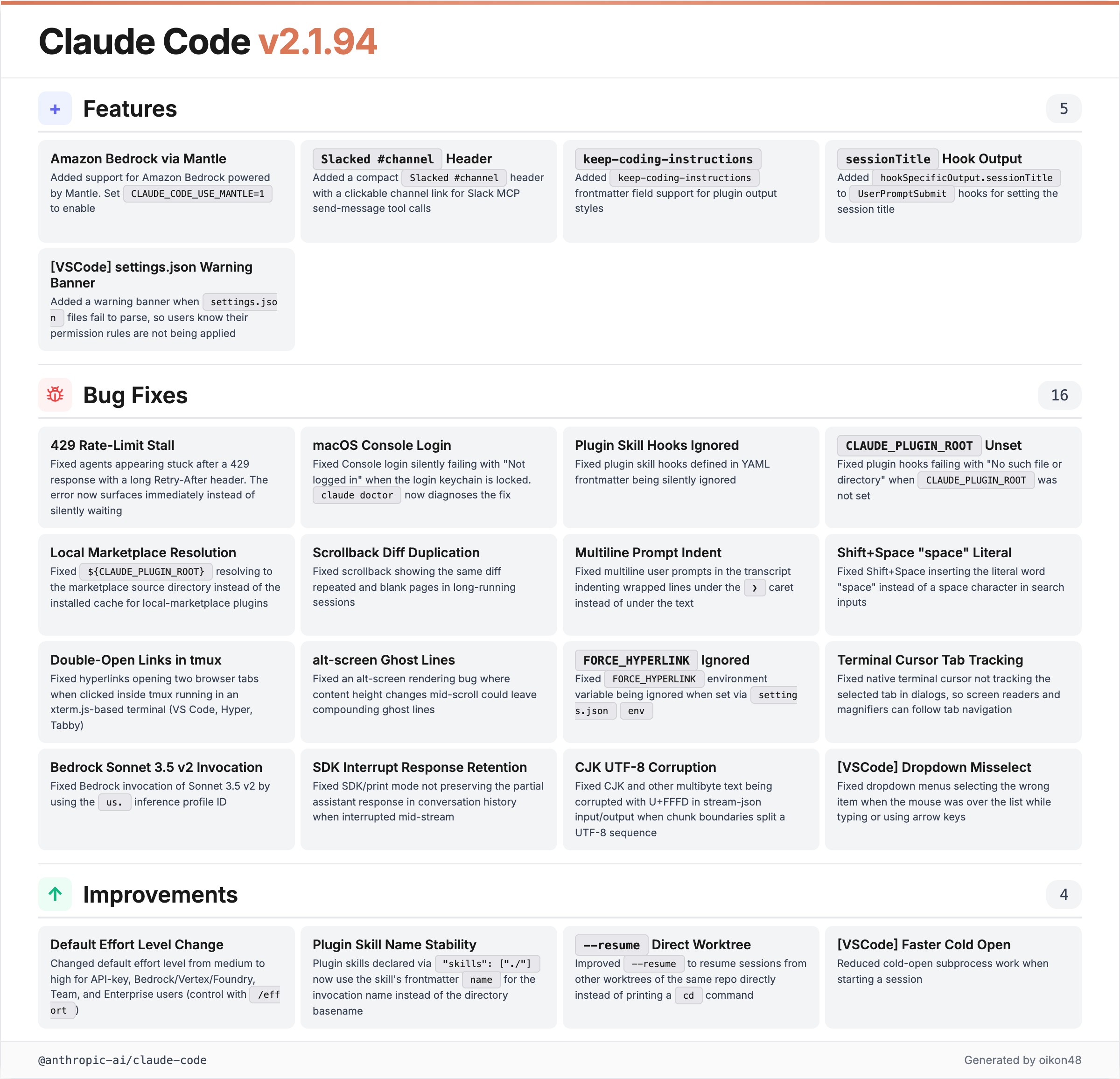
v2.1.94 & v2.1.96 (26 changes)
/autofix-pr command
This one isn’t in the v2.1.94 CHANGELOG, but the /autofix-pr command is now available. Running it after opening a pull request automatically fixes PR review comments and CI pipeline errors in the Claude Code on the Web cloud environment.
Per the official docs, the command detects the PR for the current branch with gh pr view. To target a different PR, check out its branch first. By default it addresses every CI failure and review comment, but passing a prompt narrows the scope (e.g. /autofix-pr only fix lint and type errors). It requires the gh CLI, Claude Code on the Web access, and the Claude GitHub App installed on the repository.
One thing to watch: review-comment replies from Claude are posted under your GitHub account (each reply is labeled as coming from Claude Code). If your repo uses automation triggered on issue_comment events (Atlantis, Terraform Cloud, custom GitHub Actions), audit those workflows before enabling auto-fix.
v2.1.97 (46 changes)
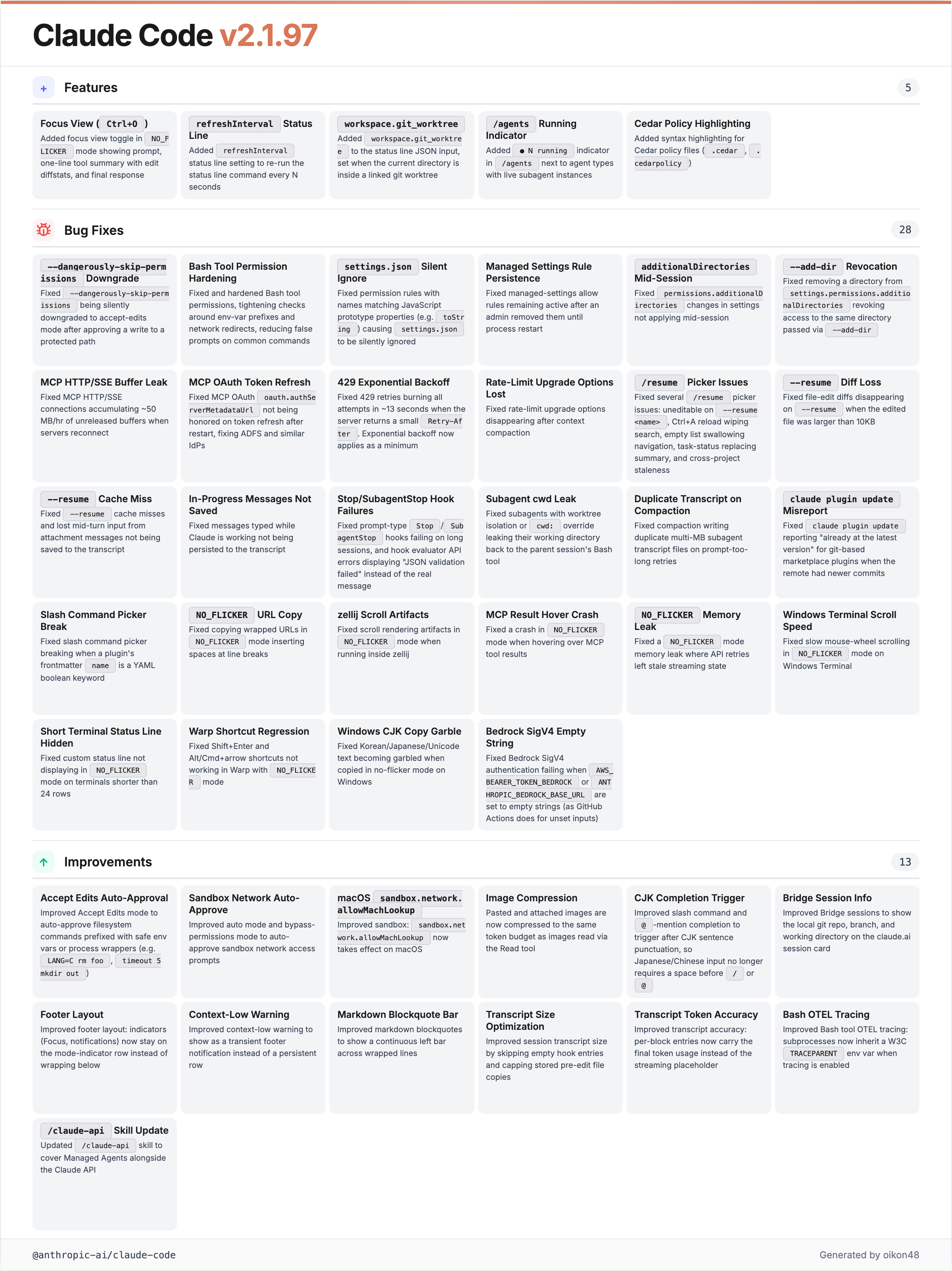
NO_FLICKER focus view (Ctrl+O)
Added focus view toggle (
Ctrl+O) inNO_FLICKERmode showing prompt, one-line tool summary with edit diffstats, and final response
In CLAUDE_CODE_NO_FLICKER=1 mode, pressing Ctrl+O toggles a focus view that shows just the prompt, a one-line tool summary with edit diffstats, and the final response. Useful when you want to collapse long tool output.
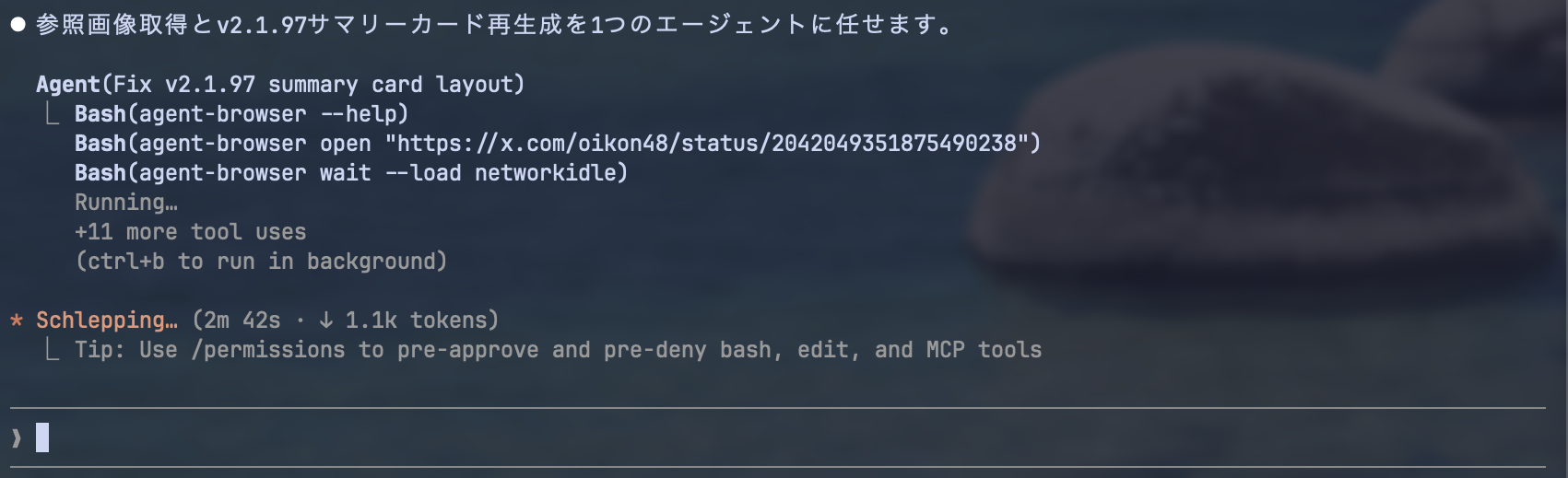
Here’s the difference. With focus view ON, subagent and Bash intermediate output collapses, leaving only the latest one-line status and the Tip.

Without focus view, subagent and Bash tool calls remain visible in detail.
v2.1.98 (57 changes)
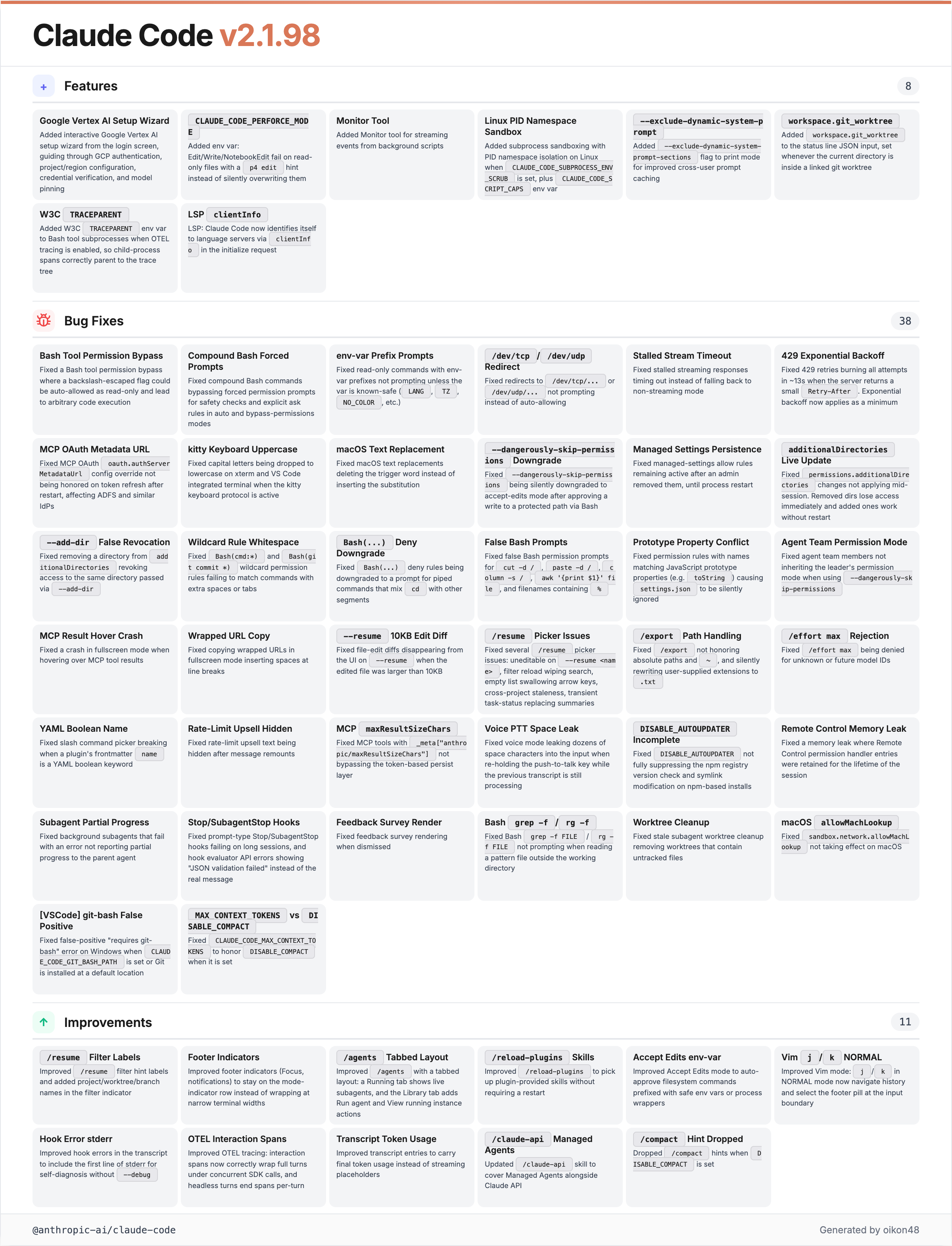
Monitor tool
Added Monitor tool for streaming events from background scripts
The Monitor tool has been added to Claude Code. Claude writes a small monitoring script, runs it in the background, and starts watching. You keep working in the same session; when an event fires, Claude interrupts to let you know.
The official tools reference lists the intended use cases.
- Tail a log file and flag errors as they appear
- Poll a PR or CI job and report status changes
- Watch a directory for file changes
- Track output from any long-running script you point it at
Monitor shares permission rules with Bash: the allow / deny patterns you have set for Bash apply directly. Note that it is not available on Amazon Bedrock, Google Vertex AI, or Microsoft Foundry. Works in both the CLI and desktop app.
Feature outside the release notes: /advisor (v2.1.100)
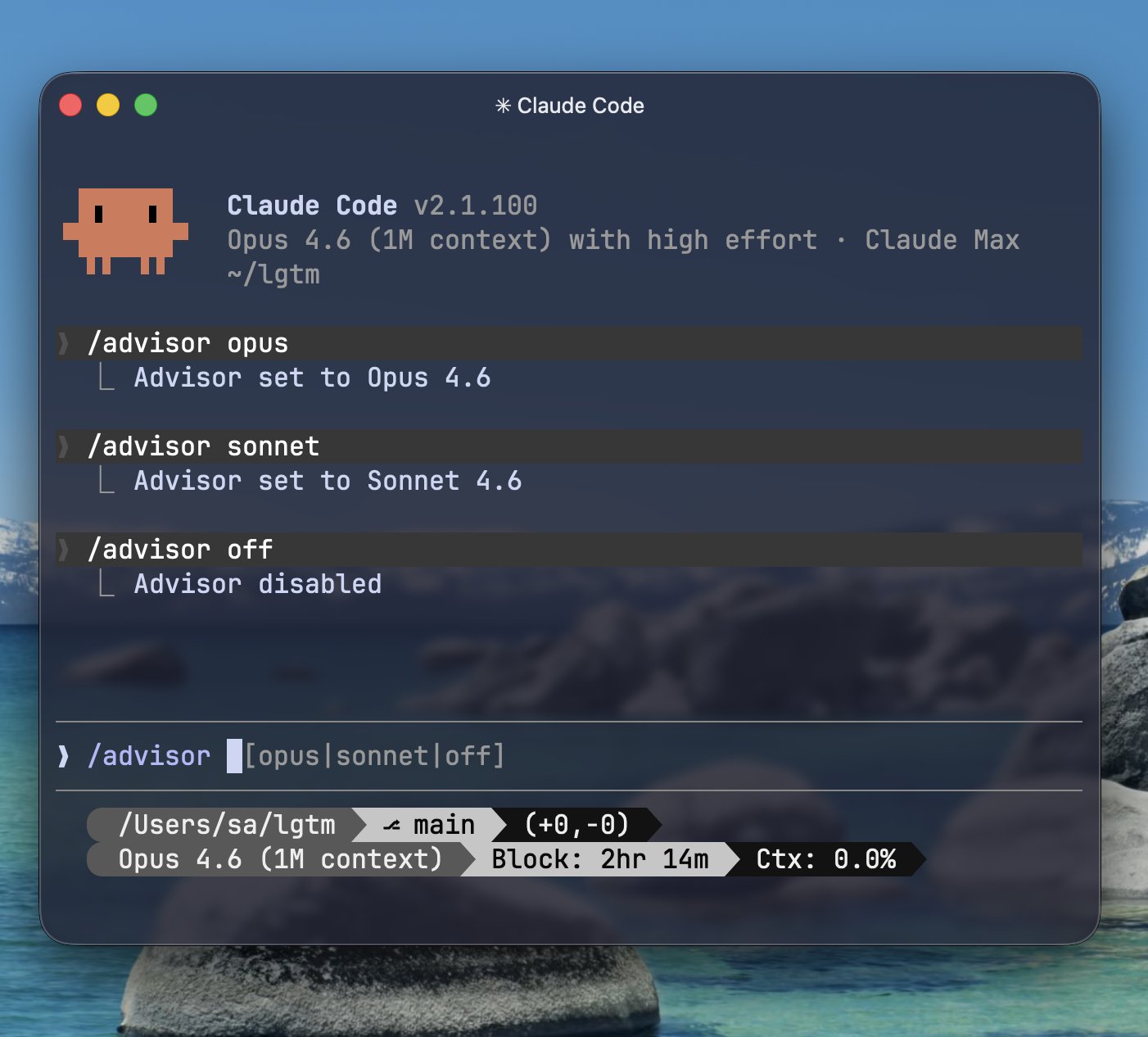
The /advisor command became available with Claude Code 2.1.100. v2.1.100 itself has no CHANGELOG entry at the time of writing; it shipped as an “unannounced” feature.
/advisor [ opus | sonnet | off ]Once /advisor is configured with a model, the Advisor auto-fires at key moments: before starting work, at task completion, and when errors cannot be resolved. The Advising tool spins up on its own and the specified model reviews the context. The user does not have to invoke it manually.
Under the hood, it appears to be the same mechanism as the Advisor Strategy exposed in the newly-launched Claude Managed Agents. The design seems to assume a Sonnet main / Opus advisor pattern similar to Opus Plan. Combined with API-key / Bedrock / Vertex users getting a high effort default, you can see how Anthropic is positioning the cost / quality balance across the product surface.

Claude Code 2.1.100🎉 新しく /advisor コマンドが使用できるようになっています。 /advisor [ opus | sonnet | off ] /advisor のモデルを設定することで、作業の前・タスク完了時・エラー発生して問題が解決できない時などに Advisor

In a session configured with /advisor, the Advising tool fires on its own without the user having to be aware of it. The specified model reviews the working context and returns feedback.

v2.1.101 (46 changes)
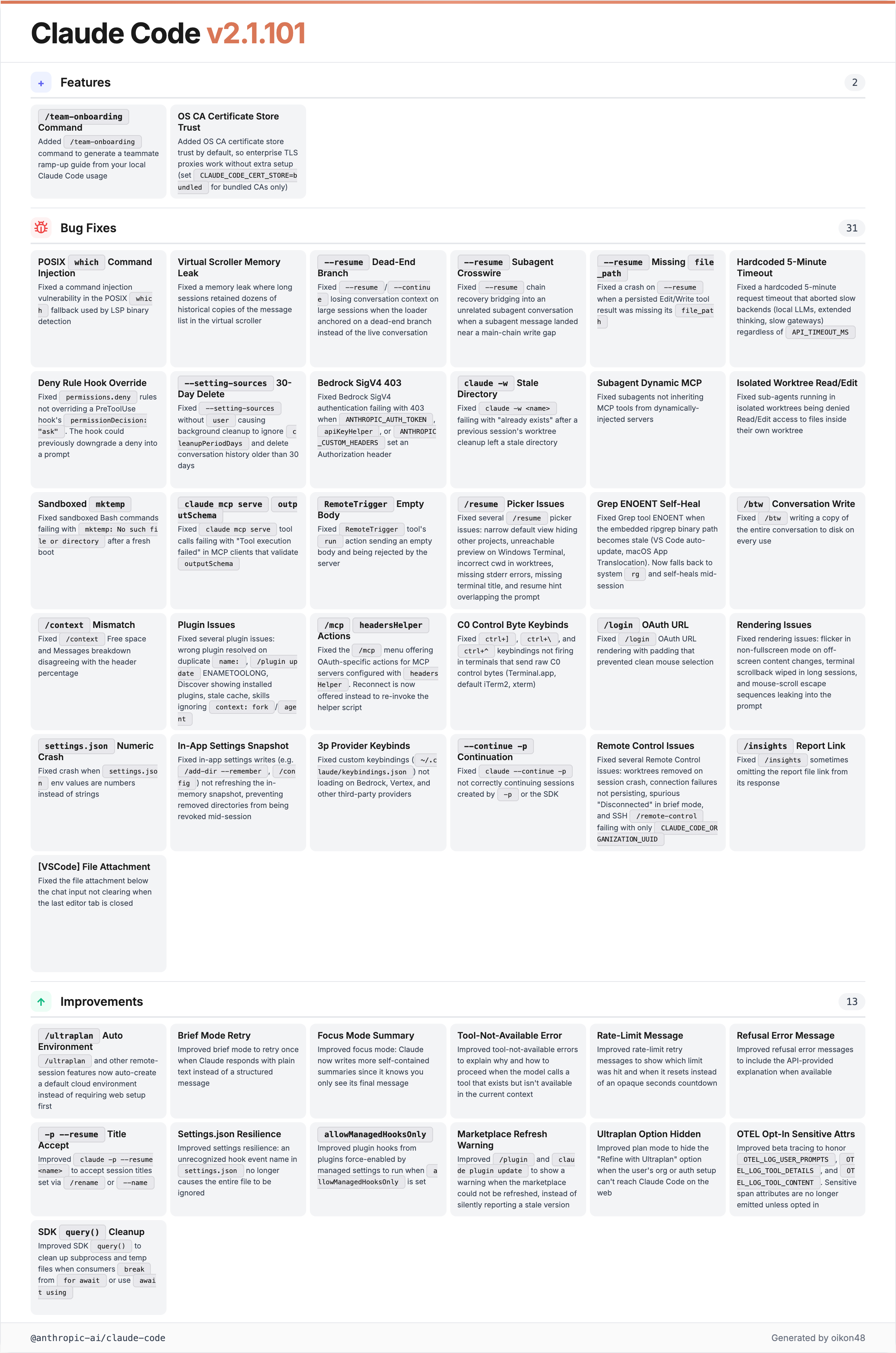
/team-onboarding command
Added
/team-onboardingcommand to generate a teammate ramp-up guide from your local Claude Code usage
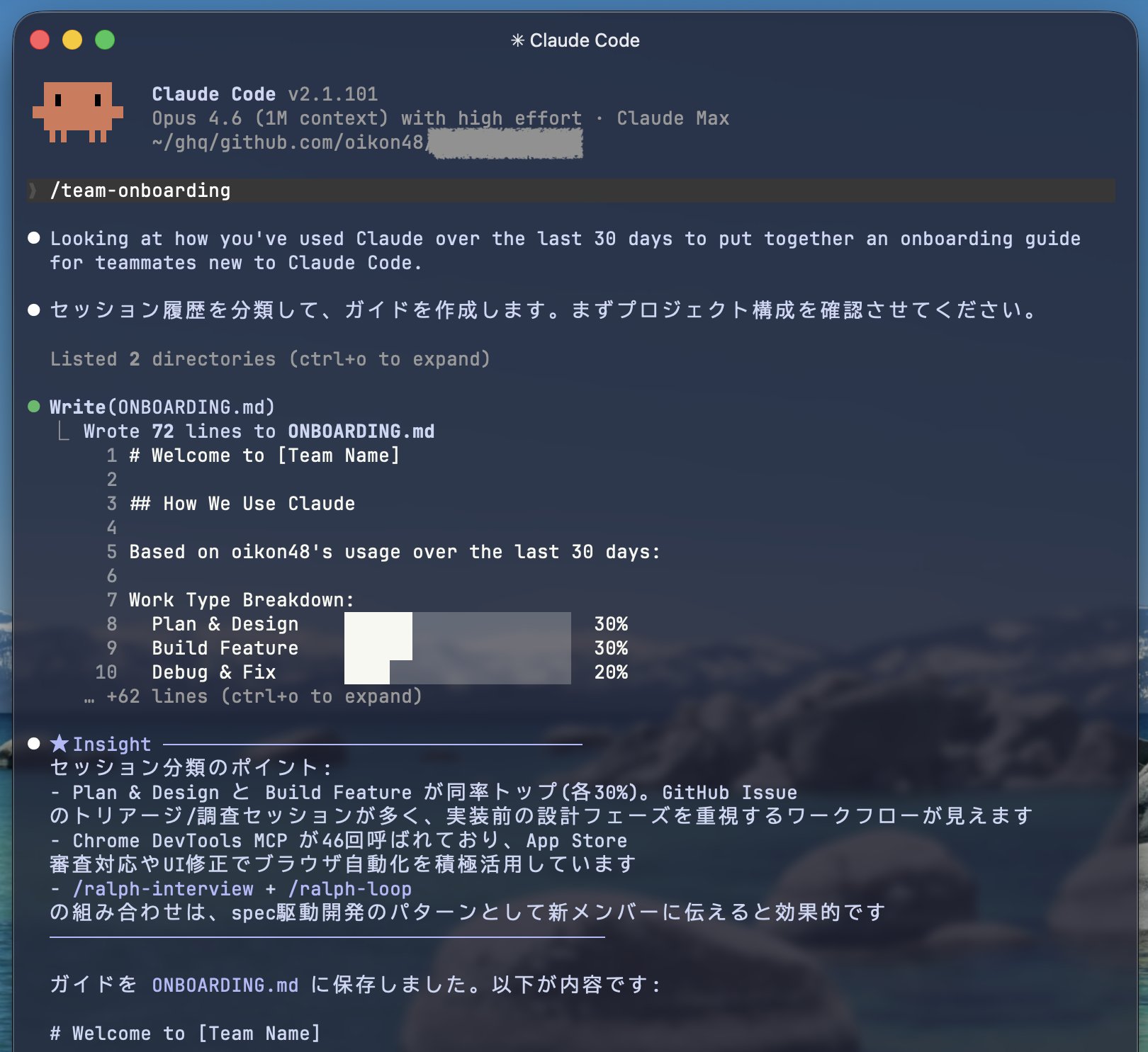
A new command that analyses your local Claude Code usage history and project structure, then generates an onboarding document (ONBOARDING.md). The intended workflow is to hand ONBOARDING.md to new teammates so they can ramp up alongside Claude Code, picking up project context and skills together.
This feels less like a replacement for CLAUDE.md and more like a transient document aimed at new teammates specifically.
Running it produces an onboarding document like the one below. It pulls together project structure, frequently-used commands, and patterns from past sessions into a quick-start page for new teammates.
/ultraplan auto-creates cloud environments
/ultraplanand other remote-session features now auto-create a default cloud environment instead of requiring web setup first
/ultraplan and other remote-session features now auto-provision a default cloud environment instead of requiring web setup up-front. Lower friction for getting started with Ultraplan.
Other Claude Code Topics
Claude Managed Agents public beta
Anthropic has launched Claude Managed Agents in public beta. It is an API suite that makes it easy to build, deploy, and compose agents at scale in the cloud, offering production-grade agents, long-running sessions, multi-agent coordination, and governance primitives.
The announcement graphic lays out four pillars: “Production-ready agents,” “Long-running sessions,” “Multi-agent workflows,” and “Governance.” This area is easier to grasp once you try it, so the early write-ups already out there are useful for getting the concepts down.
Claude Managed Agent がパブリックベータで公開。 簡単にいうとクラウド上でエージェントの大規模な構築・デプロイが簡単でき、さらに組み合わせも可能なAPI suite。本番レベルのエージェント・長時間実行セッション・マルチエージェント連携・信頼できるガバナンスがAnthropicから提供される。


Introducing Claude Managed Agents: everything you need to build and deploy agents at scale. It pairs an agent harness tuned for performance with production infrastructure, so you can go from prototype to launch in days. Now in public beta on the Claude Platform.
Advisor Strategy (API)
Anthropic has also added the Advisor Strategy to the Claude Platform. The idea is to let cheaper models like Haiku or Sonnet consult a smarter model like Opus while working. It is conceptually close to Claude Code’s Opus Plan mode.
How to use:
- Add the beta header:
anthropic-beta: advisor-tool-2026-03-01 - Add an
advisorentry to your tool definitions
The /advisor command in Claude Code covered above appears to be this same Advisor Strategy exposed through the Claude Code harness.
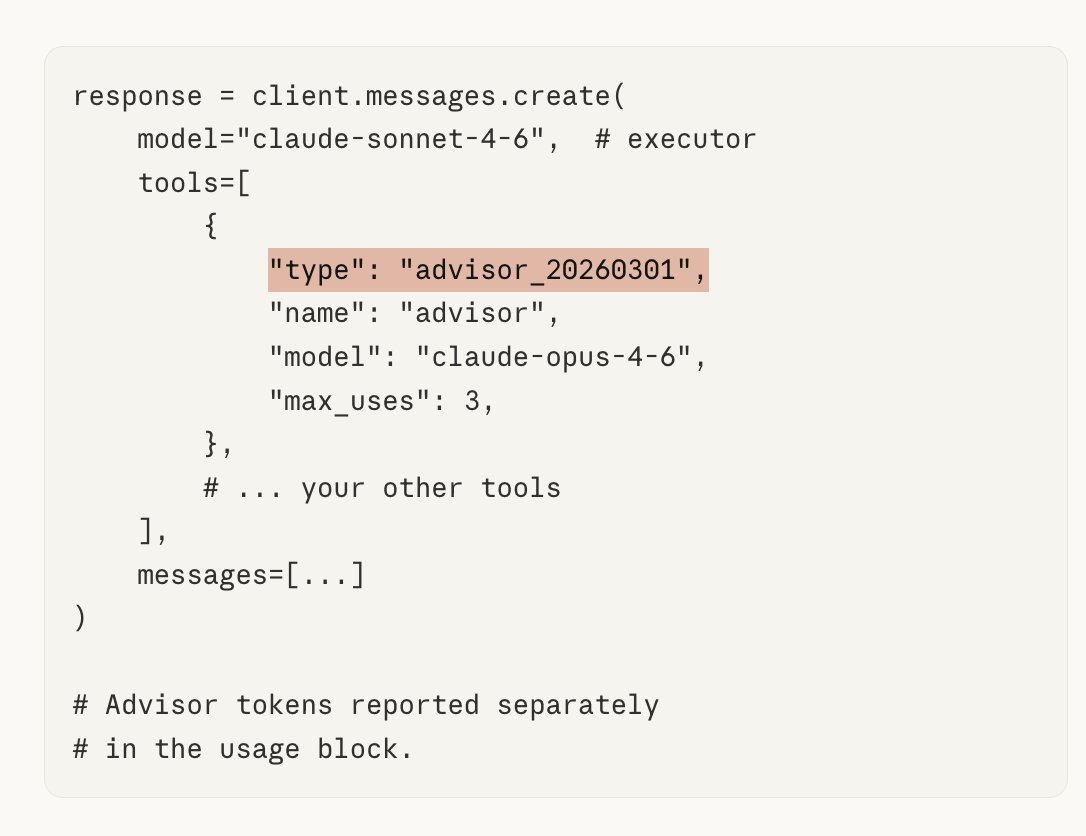
We're bringing the advisor strategy to the Claude Platform. Pair Opus as an advisor with Sonnet or Haiku as an executor, and get near Opus-level intelligence in your agents at a fraction of the cost.

/ultraplan officially announced
Claude Code’s /ultraplan has been officially announced. It lets you run Plan asynchronously on Claude Code on the Web. It was effectively usable starting a week or so ago, but between this week’s public announcement and the v2.1.101 auto-cloud-environment improvement, it now has a proper release shape.
Per the official docs, Ultraplan is in research preview and requires Claude Code v2.1.91 or later. Three launch methods are supported:
/ultraplan <prompt>command- Including the keyword
ultraplananywhere in a normal prompt - Selecting “refine with Ultraplan on Claude Code on the web” from the approval dialog when a local Plan mode finishes
The CLI shows three status indicators (◇ ultraplan, ◇ ultraplan needs your input, ◆ ultraplan ready), and /tasks exposes the session link and a Stop action. Once the plan looks right, choose either “Approve Claude’s plan and start coding” to run in the cloud, or “Approve plan and teleport back to terminal” to execute locally. Requires a Claude Code on the Web account and a GitHub repository; not available on Amazon Bedrock, Google Vertex AI, or Microsoft Foundry.
Anthropic’s Thariq posted an Ultraplan intro video. It walks through the full flow: leaving inline comments on specific sections of the plan in the browser, iterating with Claude, and choosing where to execute.
Claude Mythos Preview
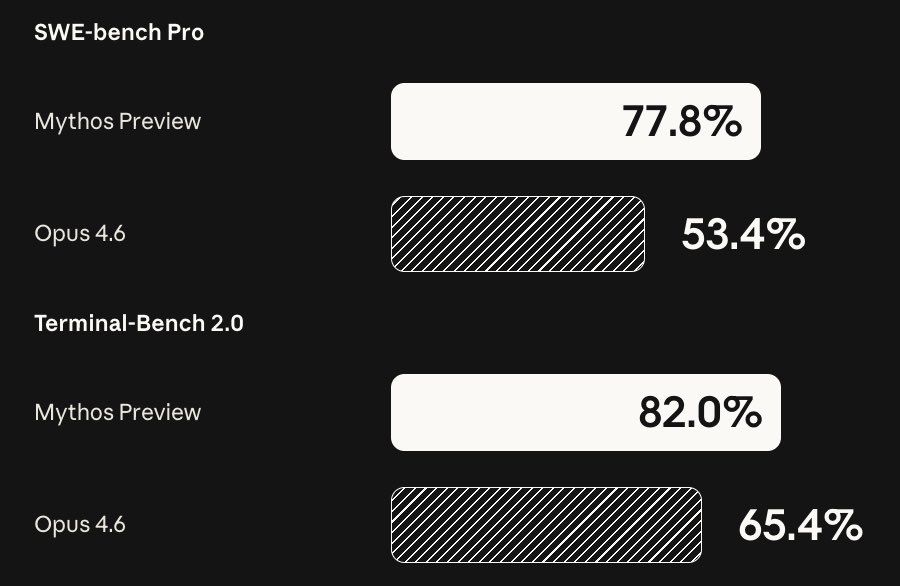
Anthropic’s Project Glasswing post mentions Claude Mythos Preview. It is described as a very powerful model currently being used with partner companies to fix vulnerabilities in existing code.
Public benchmarks show Mythos Preview coming out ahead of Opus 4.6 across multiple dimensions. How it surfaces for coding use is still unclear, but it is a strong signal that the model lineup continues to expand.
Closing
Thank you for reading!