Thoughts on Kiro's Release and Recent AI Coding Tools
This article was written manually.
Trigger: Kiro’s Release
I’m Oikon.
On July 14, 2025, the Kiro Preview version AI editor was released. The icon is very cute.
At the time of writing, Kiro is on a waitlist.
Kiro’s release received various reactions from engineers.
Since Kiro is still a Preview version, I don’t think we should judge it yet, but from what I’ve seen, reactions are mixed:
- Amazon released an AI editor!
- Another VSCode fork
- The requirements definition feature is great!
- Isn’t Claude Code enough?
Kiro’s release became an opportunity for me to reconsider AI coding tools. In this article, I’ll ramble about:
- Tools before Kiro’s release
- Kiro’s release and features
- Thoughts on recent AI coding tools
Tools Before Kiro’s Release
IDE Type (GitHub Copilot, Cursor, Windsurf, etc.)
Recent AI coding tools support natural language code generation. The pioneer was GitHub Copilot. Since appearing as a plugin (extension) for VSCode, which was mainstream since 2021, it has led AI editors. At that time, it was merely an additional feature—“an AI chat to support coding in the IDE.”
In 2023-2024, Cursor and Windsurf emerged. Being VSCode forks, VSCode users could quickly get used to the feel. They’ve gained popularity as AI-First IDEs. By pressing Tab in the editor, you can adopt code completions suggested by AI agents, improving development efficiency.
Various other IDE-type AI coding tools have emerged beyond those mentioned above. Most share the characteristic of “having AI agents support coding”.
CLI Type (Claude Code, Gemini CLI, etc.)
As of July 2025, CLI-type AI coding tools like Claude Code and Gemini CLI have risen. Devin was also a topic around 2024, but many couldn’t afford it due to pricing.
Recent CLI-type tools are characterized by “AI agents autonomously coding through testing.” While IDE-type GitHub Copilot and Cursor felt like pair programming, Claude Code and Gemini CLI are often described as asking a junior engineer to code.
With AI model performance improvements, we can now delegate reasonably substantial work to AI coding tools.
Kiro’s Release and Features
On July 15, 2025, the Kiro Preview version AI editor was released. Being a VSCode fork, it’s classified as IDE-type.
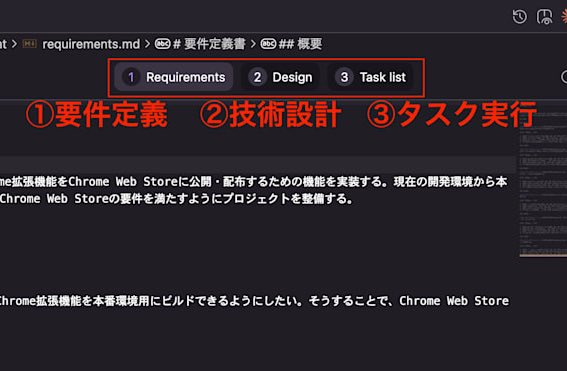
Kiro’s characteristic is Spec-Driven Development. This approach clearly defines “what to build” before AI starts coding.
Traditional AI coding tools (Cursor, Claude Code, etc.) had the issue that while they’re easy to introduce for individual or small-scale development, at large-scale development, AI couldn’t fully understand projects or large codebases. Also, autonomously driving coding AI agents like Claude Code are tools like cars with poor steering. Recently, there’s been much discussion about the need for guardrails like rules and tests.
Kiro clearly addresses these challenges:
- Specs: Establish requirements definition, technical design, and implementation plans
- Hooks: Perform specific tasks at certain events
- Steering: Provide persistent project knowledge
Kiro’s main features above all seem to target medium to large-scale software development environments. Since Kiro is from AWS (Amazon Web Services), it clearly reflects thoughts on how to handle AI agents in projects.
Currently being a preview version, there are noted issues with available models and execution speed, but when officially released, it will likely be used primarily by enterprises. Especially since it’s a product from AWS as a platform provider, there’s significant potential for adoption.
Thoughts on Recent AI Coding Tools
I’ve introduced features of recent AI coding tools, and now I’d like to ramble about my personal thoughts:
- Model providers have strong positions
- CLI tools are strong
- AI coding tool usage varies by development scale
- Coding will change as AI model performance improves
Let me explain each in detail.
Model Providers Have Strong Positions
Regarding AI coding tools, I feel “model providers are strong.” The main model providers include:
- OpenAI: GPT-4, o3, etc.
- Anthropic: Claude 4 Opus, Claude 4 Sonnet, etc.
- Google: Gemini 2.5 Pro, etc.
These companies can directly embed their models in their services and tune their products to match those models. I felt model providers were particularly strong with Claude Code, which is very well designed for coding to match Claude 4’s characteristics.
Cursor and Windsurf have the advantage of selecting or combining multiple model providers, but there are also issues with partnerships being cut due to corporate relationships. Recently, when rumors arose about OpenAI acquiring Windsurf, Anthropic temporarily cut their partnership (the acquisition didn’t happen in the end). The recently released Kiro also uses Claude due to Amazon and Anthropic’s partnership, making it dependent on Anthropic.
Going forward, AI coding tools will continue to evolve centered on these three companies.
CLI Tools Are Strong
Having discussed IDE-type and CLI-type AI coding tools, I personally feel CLI tools are strong in the following aspects:
- UI doesn’t become a development hindrance
- Can be flexibly integrated from command line to IDE
- High extensibility with easy wrapper and utility creation
IDE-type tools necessarily require crafting user interfaces and don’t have high extensibility. On the other hand, CLI-type tools can be used not just in terminals but can easily integrate with IDEs, serving a wide range of users. They can also connect command-line tools together, making them easy to embed in systems.
As AI model performance improves, we spend less time watching the coding process and can just evaluate the final AI agent output—I think this is also why CLI tools have risen.
AI Coding Tool Usage Varies by Development Scale
Through Kiro’s release, I’ve become more aware that AI coding tool usage changes significantly by development scale.
For individual to small-scale development, the mindset of having AI agents work extensively to create multiple outputs and selecting the best one is good. Recently, flat-rate AI coding tools have emerged instead of API pay-per-use, so feel free to use AI agents extensively.
On the other hand, in medium to large-scale development, even when using AI coding tools extensively, issues arise where expected outputs aren’t achieved, resulting in rework. This is because current AI models can’t hold large project rules and code in their context window and can’t fully understand entire projects. In such cases, I feel running AI coding tools after establishing guardrails through spec-driven development like Kiro is more effective.
Coding Will Change as AI Model Performance Improves
I’ve been rambling about AI coding tools, but what I personally want to keep in mind is that “the situation can completely change anytime AI model performance improves.” Claude Code, which I often mention, wasn’t even noticed when Claude 3.7’s AI model performance was low, even though it could drive autonomously.
Also, when using current AI models for coding, context window size is often an issue. Many engineers work daily on how to compress context without polluting the context window, but I think this problem will likely be solved in the future.
AI models will definitely evolve going forward, so it’s good to be prepared to review coding approaches each time.
Summary
Recently, the variety of AI coding tools has enriched, allowing various development approaches.
Not just Kiro highlighted here, but I think even more evolved AI coding tools will emerge.
It would be nice to maintain an overview while choosing tools suited to your needs to use them well.
Follow Me on 𝕏
I also share information on 𝕏, so I’d appreciate it if you followed me!

References